
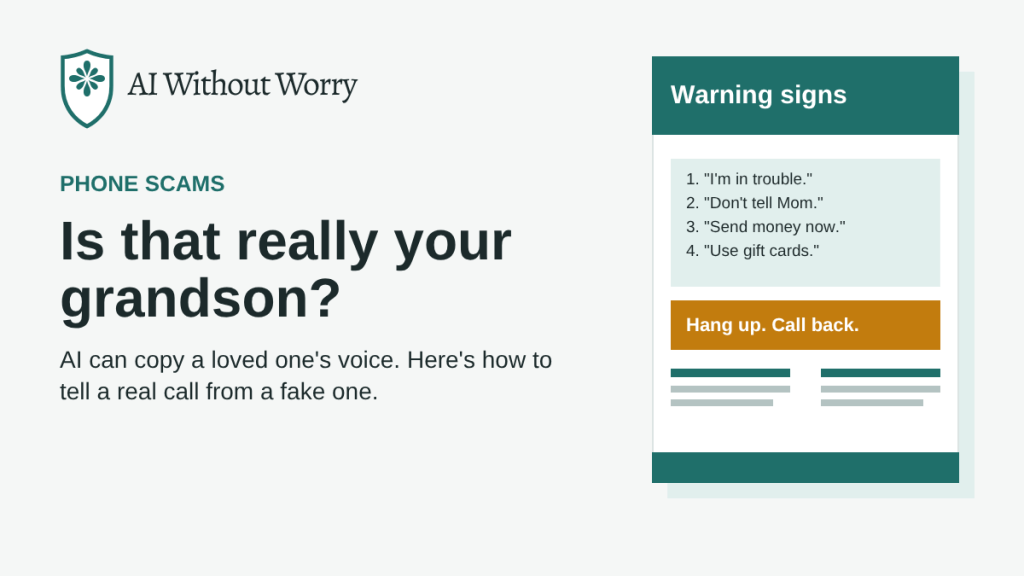
In short: Scammers can use AI to copy a family member’s voice from a short clip posted online. If you get an urgent call asking for money, hang up and call the person back on a number you know. A family safe word adds another layer of protection.
The call that sounds like family
The phone rings, and it sounds like your grandson. He’s upset. He says he’s been in a car accident, or he’s been arrested, and he needs money right away. He asks you not to tell his parents.
For years, this has been known as the “grandparent scam.” What has changed is the voice. With artificial intelligence, or AI, computer programs can learn to copy the way a person sounds. That means a scammer can make a caller sound like someone you love.
How voice cloning works
According to the Federal Trade Commission, a scammer may need only a short audio clip of your family member’s voice. That clip can come from a video or other content posted online. A voice-cloning program then uses it to create new speech that sounds like that person.
In December 2024, the FBI warned that criminals are creating short audio clips of a loved one’s voice to pose as a relative in a crisis and ask for urgent money or a ransom.
The voice may sound completely real. That’s exactly why you can’t rely on the voice alone.
Warning signs
- The caller needs money right now and says there’s no time to check.
- They ask you to keep it a secret, especially from other family members.
- They want you to pay by wire transfer, cryptocurrency, or gift cards. The FTC notes these payments are hard to get back.
- The story is frightening, which makes it harder to think clearly.
What to do if you get a call like this
- Stay calm, and don’t send money during the call.
- Hang up, even if the voice sounds exactly right.
- Call the person back on a number you already have for them. If you can’t reach them, call another family member or a friend who can check.
- Ask for your family safe word, if you’ve set one up.
- Never pay with gift cards, wire transfers, or cryptocurrency to someone who called you out of the blue.
Set up a family safe word today
The FBI recommends that families agree on a secret word or phrase. Anyone who calls asking for urgent help or money should be able to say it. If they can’t, hang up and call them directly.
Choose something easy to remember but hard to guess. Avoid pet names, birthdays, or anything you’ve posted online. Share it in person or on a phone call you started, not by text or social media.
Limit what scammers can copy
The FBI also suggests limiting how much of your voice is posted online and keeping social media accounts private, so only people you know can see your posts. It’s worth a quick family conversation, especially with grandchildren who post videos often.
If you already sent money
- Contact your bank, card company, or payment service right away. The sooner you act, the better your chances.
- Report it to the FTC at ReportFraud.ftc.gov and to the FBI at ic3.gov.
- Tell a family member or friend. Scammers sometimes call back with a new story.
You did nothing wrong. These scams are designed to fool caring, careful people.
Sources: Federal Trade Commission, “Scammers use AI to enhance their family emergency schemes” (March 20, 2023). FBI Internet Crime Complaint Center, public service announcement I-120324-PSA (December 3, 2024).
Get the free guide
Download our one-page guide, Is This Call Real?, and get a short scam alert every Thursday.

