
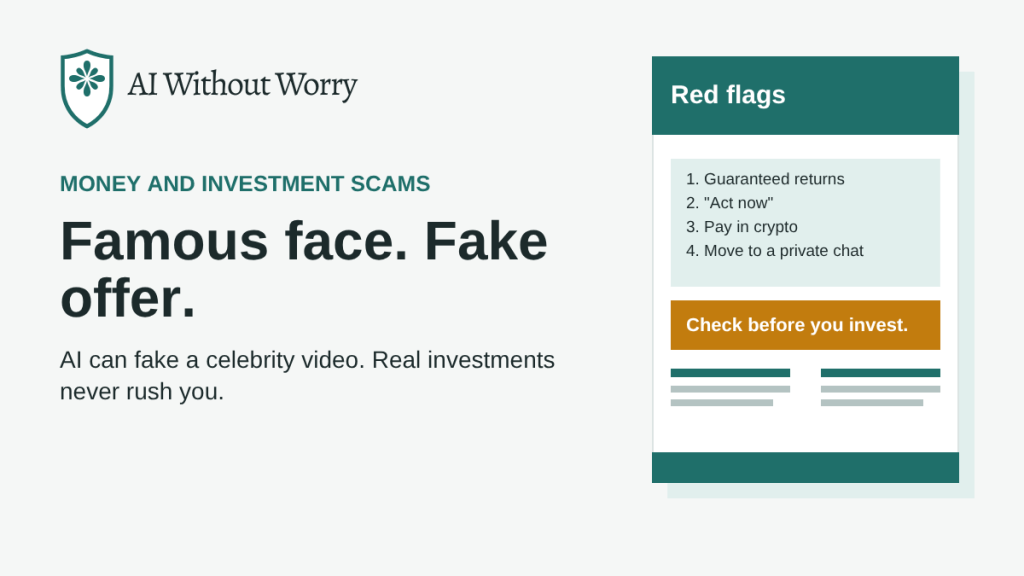
In short: Scammers use AI to make videos in which famous people appear to recommend an investment. These videos show up in social media feeds, online ads, and fake livestreams. A real investment opportunity won’t come from a celebrity video urging you to act fast. Don’t send money, and check any investment on your own first.
A familiar face, a fake message
You’re scrolling through social media and see a video of a famous business leader. He’s recommending a new investment and says the returns are guaranteed. It looks and sounds real.
It may be a deepfake. A deepfake is a video or audio clip that has been changed with AI to make someone appear to say or do something they never did.
How the scam works
In August 2024, the New York Attorney General warned about investment scams that use AI-changed videos of famous people such as Elon Musk, Jeff Bezos, and Warren Buffett. According to that warning:
- The videos appear in social media feeds, online ads, messaging apps, and fake livestreams on sites like YouTube.
- Viewers are moved to private messaging apps and urged to make a first investment, often in cryptocurrency.
- A fake investment website shows big profits to get people to send more money.
- When people try to withdraw their money, they’re told to pay “fees” or “taxes,” or the money is simply gone.
The FBI has also warned that criminals use AI-generated videos of public figures to make their scams more believable.
The New York Attorney General notes that it can be difficult to tell from the video alone whether it’s a deepfake. Even something that looks like a live broadcast could be fake.
Red flags
- Guaranteed returns. Real investments always carry some risk.
- Pressure to act now. The New York Attorney General notes that real firms don’t push people to decide quickly.
- A celebrity endorsement, especially in an ad or social media post.
- Requests to pay in cryptocurrency, or to send money to a website or company you’ve never heard of.
- Being moved to a private messaging app to continue the conversation.
Signs a video may be fake
The FBI suggests watching for:
- Jerky, unnatural movements, or delays in how the person responds
- Odd details, such as distorted hands, unrealistic teeth or eyes, shadows that don’t match, or strange-looking glasses or jewelry
Keep in mind that some fakes are very good. If a video asks for money, treat it as a scam until you’ve proven otherwise, no matter how real it looks.
How to protect your savings
- Never invest through a link in an ad, video, or message.
- Look up the person or firm on FINRA BrokerCheck to see whether they’re registered.
- Talk to someone you trust, such as a family member, your bank, or a financial advisor you already know, before moving any money.
- Don’t share personal, financial, or login information with someone you’ve only met online.
- Turn on two-step login for your bank, investment, and email accounts.
If you already invested
- Stop sending money, even if you’re told a fee will unlock your funds.
- Contact your bank or payment service right away.
- Report it at ReportFraud.ftc.gov and ic3.gov. Keep copies of every message and payment.
- Be careful of anyone who offers to recover your money for a fee. The New York Attorney General warns that fake “recovery services” often target people who have already been scammed.
Money sent this way is almost never returned, so act quickly.
Sources: New York State Attorney General, “Investor Alert: Attorney General James Warns New Yorkers of Investment Scams Using AI-Manipulated Videos” (August 29, 2024). FBI Internet Crime Complaint Center, public service announcement I-120324-PSA (December 3, 2024).
Stay a step ahead
Get one short scam alert and one helpful AI tip every Thursday, plus our free guide, Is This Call Real?

